PP Corrugated Sheets in 2026: Reusable Packaging Trends Reshape European And Australian Markets
Sep 23, 2026
As manufacturers, logistics companies, distributors, and packaging buyers across Europe and Australia continue to look for more durable, reusable, and recyclable packaging solutions, polypropylene (PP) corrugated sheets are attracting growing attention in industrial packaging and logistics applications.
The change is not simply about replacing one packaging material with another. Increasingly, companies are evaluating packaging based on its service life, reusability, moisture resistance, transport efficiency, and end-of-life recyclability. This shift is creating new opportunities for PP corrugated products, particularly in applications where conventional cardboard or other single-use materials may not provide sufficient durability.

In Europe, one of the most important developments for the packaging industry in 2026 is the application of the European Union's Packaging and Packaging Waste Regulation (PPWR). The European Commission announced that the regulation began applying across the EU on 12 August 2026. The regulation establishes a harmonised framework covering the packaging life cycle and aims to reduce packaging waste, promote reuse and recycling, and support the development of a circular economy.
For transport and logistics packaging, this direction is particularly relevant. From 2030, EU economic operators will face requirements related to the reuse of transport and sales packaging, subject to specific conditions and exemptions. The European Commission is also developing further guidance covering areas such as reuse, recyclability, labelling, and recycled content.
These developments do not mean that every packaging product must immediately be replaced with PP corrugated material. However, they are encouraging companies to take a closer look at whether packaging can be reused multiple times, withstand repeated handling, reduce material consumption over its service life, perform reliably in humid environments, and be recycled at the end of its useful life.
These are areas where PP corrugated sheets can provide practical advantages. The fluted structure of PP corrugated sheets allows manufacturers to achieve a combination of relatively low weight and structural rigidity. Unlike paper-based materials, PP is resistant to moisture and does not absorb water in the same way as cardboard. This makes PP corrugated sheets suitable for applications involving humidity, condensation, cleaning, and certain outdoor environments.
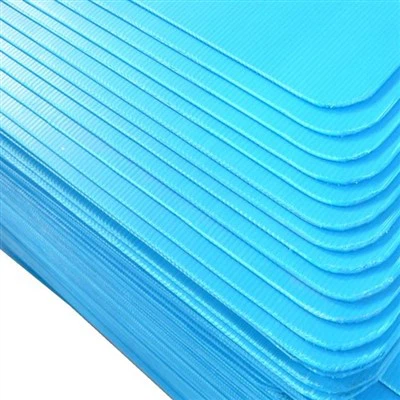
Another important advantage is reusability. Depending on the specification and application, PP corrugated sheets can be used repeatedly as layer pads, pallet separators, dividers, protective panels, box liners, and other packaging components. Their relatively smooth surface can also make them easier to clean, which is valuable in applications where hygiene and repeated use are important.
Customisation is another factor driving interest in PP corrugated products. Manufacturers can adjust thickness, GSM, dimensions, colour, printing, flute structure, UV resistance, die-cutting, welding, edge treatment, and other characteristics according to the application. This allows packaging buyers to select a specification based on actual performance requirements instead of relying on a one-size-fits-all solution.
One increasingly relevant application is returnable transport packaging. In industries such as automotive, electronics, food processing, agriculture, and general manufacturing, packaging components may need to survive repeated transportation and handling cycles. PP corrugated sheets can be used for pallet separators, layer pads, protective sheets, dividers, partitions, box liners, and other reusable packaging components.
The economic value of these products is also changing. Instead of evaluating packaging only according to its initial purchase price, companies are increasingly considering the cost per use over the expected service life. A packaging component that costs more initially but can be reused many times may provide a different overall economic value compared with a lower-cost single-use alternative.
Australia is also moving toward a more circular approach to packaging and resource management. The Australian Government is working on packaging and recycling reforms designed to improve packaging design and support the recovery, reuse, recycling, and safe reprocessing of materials. Australian governments are also continuing to develop broader circular-economy policies.
This changing environment is particularly relevant to plastic packaging. Government data for 2023–24 shows that Australia consumed approximately 4.0 million tonnes of plastic products and packaging, while the national plastics recovery rate was 14%. Polypropylene accounted for approximately 14% of plastic consumption during that period.
For manufacturers, importers, and packaging buyers, these developments highlight the importance of considering the entire life cycle of packaging. The question is increasingly not simply whether a material is recyclable, but whether the product can be designed, used, collected, and recycled effectively within the relevant supply chain.
For PP corrugated sheet buyers, this means that product selection should go beyond thickness and price. The appropriate specification depends heavily on the intended application. Thickness and GSM affect material weight and rigidity, while flute structure and orientation can influence mechanical performance. Outdoor applications may require UV stabilisation, while applications involving hygiene or strict material requirements may call for virgin PP.
The choice between virgin PP and recycled-content PP also depends on the application. For products requiring specific appearance, hygiene, mechanical performance, or other technical characteristics, virgin PP may be preferred. For less demanding applications, recycled-content materials may provide an alternative depending on the customer's requirements and local regulations.
Packaging design should also consider the complete logistics cycle. Buyers may need to evaluate how many times a component is expected to be reused, whether it will be washed, whether it will be exposed to rain or humidity, how much weight it needs to support, how it will be transported and stored, and what will happen to it at the end of its useful life.
This application-based approach is becoming increasingly important as companies in Europe and Australia respond to changing packaging expectations. Rather than simply looking for the lowest initial purchase price, procurement teams are increasingly considering durability, reuse cycles, transportation efficiency, maintenance, material selection, and end-of-life options together.
For manufacturers of PP corrugated products, this trend also creates an opportunity to move beyond standard sheet supply and provide more application-specific solutions. By understanding the customer's actual working environment, loading conditions, expected service life, transportation method, and packaging cycle, manufacturers can recommend specifications that are better matched to the customer's requirements.
The development of reusable and more circular packaging does not mean that PP corrugated sheets are suitable for every application. Different industries and markets have different technical, regulatory, and recycling requirements. However, where the material's characteristics match the application, PP corrugated sheets can provide a practical option for companies looking to improve packaging durability, reusability, and logistics efficiency.
As packaging regulations and sustainability expectations continue to evolve in Europe and Australia, the packaging industry is gradually moving toward a more application-based approach. The key question for buyers is no longer simply, "What is the cheapest packaging material?" but rather, "What specification provides the right balance of performance, service life, logistics cost, and end-of-life management for our application?"
For companies evaluating new packaging solutions, this broader perspective can help them make more informed purchasing decisions and identify opportunities to reduce packaging waste while maintaining the performance required throughout the supply chain.
Mantis is a manufacturer specialising in PP corrugated plastic products. With in-house production and processing capabilities, Mantis provides customised PP corrugated sheets according to requirements such as thickness, GSM, dimensions, colour, printing, UV resistance, die-cutting, welding, and edge treatment.
Our PP corrugated products are used in industrial packaging, pallet protection, layer pads, dividers, warehouse protection, agriculture, advertising displays, and reusable transport packaging. For customers developing new packaging projects, we can recommend suitable material specifications based on the intended application, loading conditions, required service life, and transportation requirements.
Mantis Factory - Specialising in PP Corrugated Plastic Products.